Alternating Cheek Puff
Alternate cheek muscles to balance left-right volume.
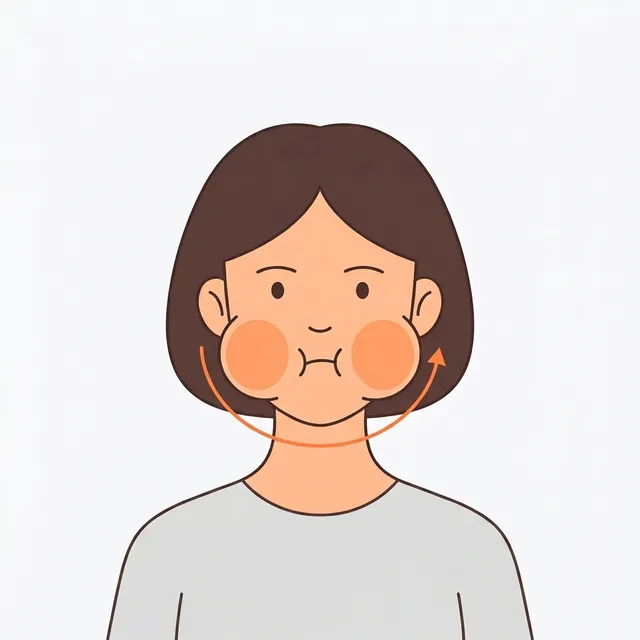
Shown as in a mirror — left and right mean your own left and right
How to do it
- 1
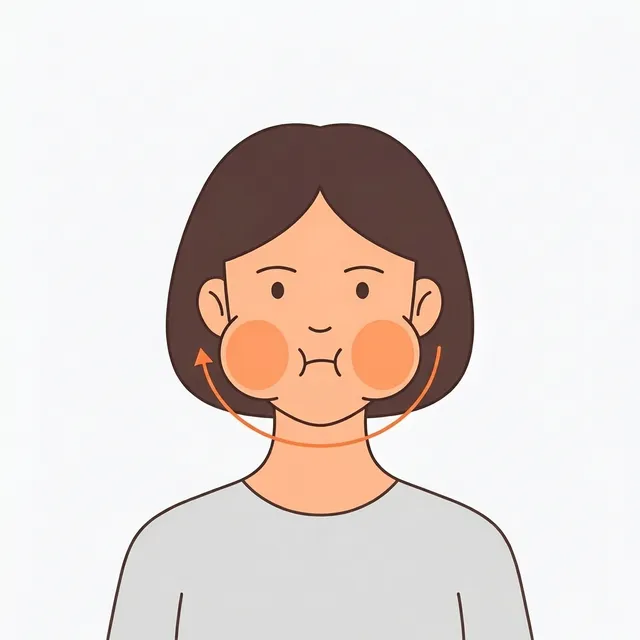
Fill your mouth with air.
- 2
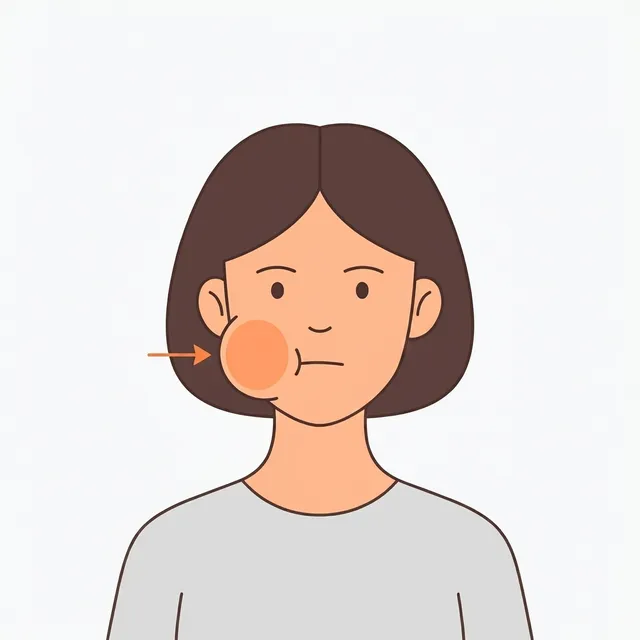
Push the air to your left cheek and hold 5 seconds.
- 3
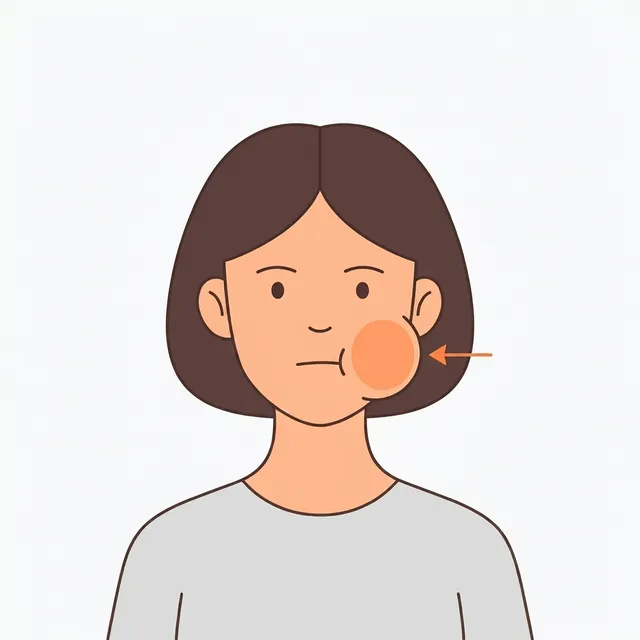
Move it to the right cheek and hold 5 seconds.
- 4
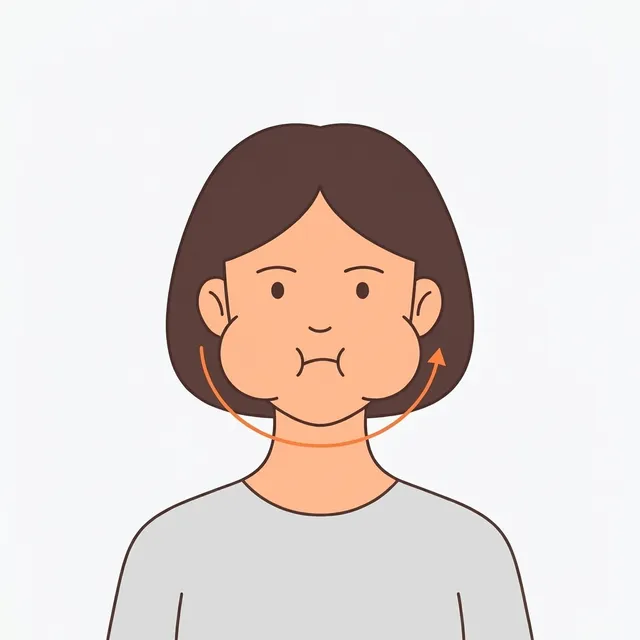
Circulate around upper/lower lips, 8 rounds total.
Authorship and evidence
Written by: ALYGN operator · content editor
Content reviewed:
Date of editorial content and source review. This does not represent review by a medical professional.
This exercise is self-care information for functional asymmetry that comes from muscle habits. Individual results and timelines vary, and the listed times and repetitions are not a medical prescription.
- Alam et al. (2018): Facial exercise and the appearance of aging ↗
An uncontrolled pilot reporting appearance ratings in 16 completers over 20 weeks. It does not establish asymmetry correction, the effect of an individual movement, this site’s score, or a timeline for change.
Why it works
Cheek muscles rarely work one side at a time in daily life, so imbalance builds up. Moving air side to side makes each cheek alternately hold (isometric work) and stretch, balancing volume and tone.
Left-right cheek differences come from three overlapping factors: muscle, fat, and fluid retention. Exercise can address two of them — muscle tone and circulation. Years of one-sided chewing or smiling maintain uneven tone, and because daily life almost never works one cheek in isolation, the gap rarely closes on its own.
Trapping air in one cheek and holding it puts the entire muscular wall of that cheek into isometric contraction — force without movement. Isometric work stimulates muscle tone without stressing joints or dragging on the skin, which suits a thin-skinned, delicate area like the face.
Muscles involved
The key muscle is the buccinator, the broad sheet forming the cheek wall — the muscle that keeps a trumpeter's cheeks from bursting and keeps food from slipping between your teeth and cheek as you chew. The orbicularis oris sealing your lips works alongside it as the air moves.
Common mistakes
- Holding the air with your lips instead of the cheek — the cheek wall should do the work.
- Inflating until it hurts — about 70% full is enough.
- Holding one side longer than the other — count seconds to keep them equal.
Signs you're doing it right
The holding cheek should feel a taut ache, and afterward your cheeks should feel warm with better circulation.
How often and when
Once or twice a day, two to three minutes per session. Attaching it to an existing habit — while washing your face or showering — makes it easy to remember. Small muscles like the cheeks respond fairly quickly: holding strength improves within two to three weeks, while visible tone changes need six consistent weeks or more.
Once it feels easy
When the basic version gets easy, extend each hold from 5 to 10 seconds and move the air more slowly and deliberately. The next step is circulating air through four stations — left, right, upper lip, lower lip — which recruits the whole ring of muscles around the mouth evenly.
Frequently asked questions
Q. Will this deepen my smile lines?
Puffing the cheek actually stretches the smile-line area outward from inside. That said, inflating painfully tight over-stretches the skin — stick to the 70%-full guideline. Wrinkles are driven by repeated expressions and skin aging, not by this exercise.
Q. Will it slim my cheeks?
It is not a fat-burning exercise. Cheek fat follows overall body-weight changes; what this trains is muscle tone and circulation. If you retain fluid often, better circulation can make cheeks look slimmer — but that is de-puffing, not fat loss.
Q. The air won't move well into one cheek.
That is common — it means the buccinator on your less-used side has poorer control, which is exactly why it needs the work. Linger two to three extra seconds on the harder side; control usually evens out within a few weeks.
Cautions
- · Over-inflating can strain the mouth area.